October–December
Read and count
Treble and bass clefs, ledger lines, note and rest values, meter, subdivisions, dots, ties, and dynamics.
Music Explorations reference
All Music Explorations sections begin this sequence Tuesday, October 6, 2026. This class complements orchestra, band, and choir. Everyone learns a common musical language, then applies it to an original piece and to a short score. You can participate whether or not you belong to an ensemble.
Use paper, a pencil, a printed staff, and the visual journal. Quiet speaking, humming, tapping, or clapping can help you test ideas. Written counting and silent tracing are participation options. Listening lessons use teacher demonstrations or school-approved audio played to the class.
Open the visual process journal library →
October–December
Treble and bass clefs, ledger lines, note and rest values, meter, subdivisions, dots, ties, and dynamics.
January–March
Whole and half steps, scales, key signatures, intervals, articulation, phrasing, texture, harmony, and listening.
March–May
Genre and cultural context, song form, lyrics, melodic writing, an original score, revision, and a portfolio connecting these skills to ensemble music.
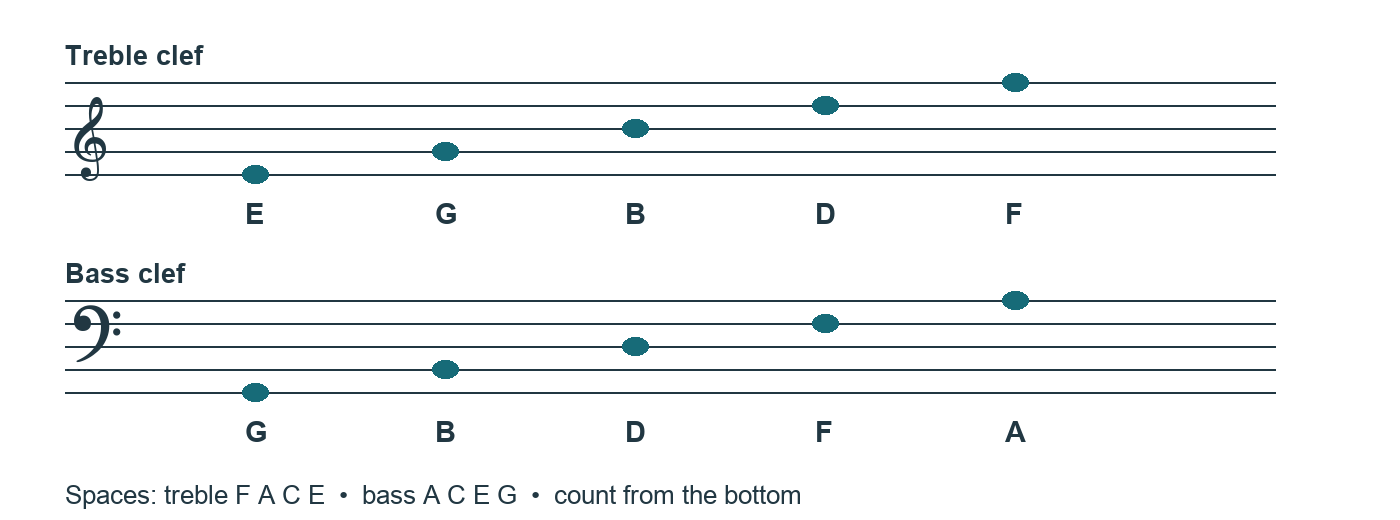
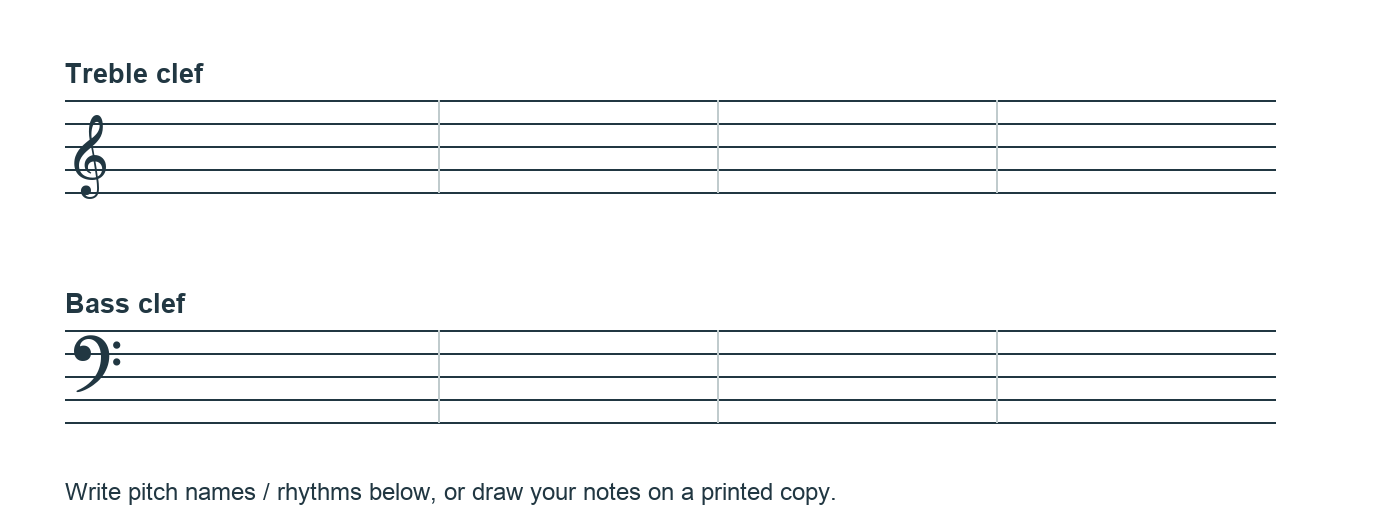
A staff has five lines and four spaces. Count them from the bottom. A clef tells you which pitches those positions represent. Moving one line or space at a time moves to the next letter name, repeating A through G.
| Clef | Lines from bottom | Spaces from bottom | Anchor |
|---|---|---|---|
| Treble | E G B D F | F A C E | G on line 2 |
| Bass | G B D F A | A C E G | F on line 4 between the two dots |
Ledger lines extend a staff. Middle C lies on one ledger line below the treble staff and one ledger line above the bass staff. Its letter name stays C when the clef changes. A sharp raises a pitch one half step; a flat lowers it one half step; a natural cancels an alteration. A written accidental generally lasts through its measure for the same pitch and octave.
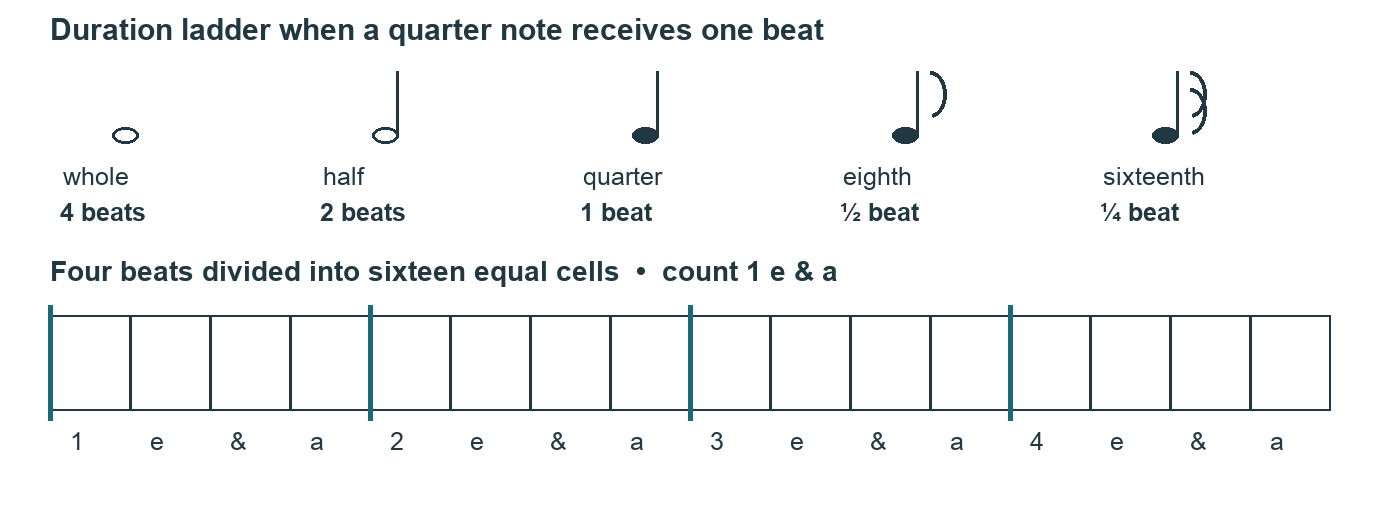
Beat is the steady pulse. Rhythm organizes sound and silence over time. A rest uses time just as a note does. These values assume a quarter note receives one beat.
| Note or matching rest | Duration | Subdivision of one quarter beat |
|---|---|---|
| Whole | 4 quarter beats | A quarter is one fourth of its duration |
| Half | 2 quarter beats | Two quarters equal one half |
| Quarter | 1 beat | 1 |
| Eighth | 1/2 beat | 1 & |
| Sixteenth | 1/4 beat | 1 e & a |
| Thirty-second extension | 1/8 beat | Eight equal parts per quarter beat |
| Eighth-note triplet | 1/3 beat | 1 trip let · three equal notes in one quarter beat |
Beams group flagged notes; the number of beams shows the subdivision. A dot adds half the note’s original duration: dotted half = 3 quarter beats, dotted quarter = 1½, dotted eighth = ¾. A tie joins the durations of two notes of the same pitch. A slur groups notes into a connected gesture and does not add their durations.
In 4/4, each bar holds four quarter-note beats. In 3/4, each holds three. In 6/8, there are six eighth-note units, usually grouped as two dotted-quarter pulses: ONE two three FOUR five six. The bottom number names the written unit; it does not always identify the felt pulse. Check the meter before assigning beat values.
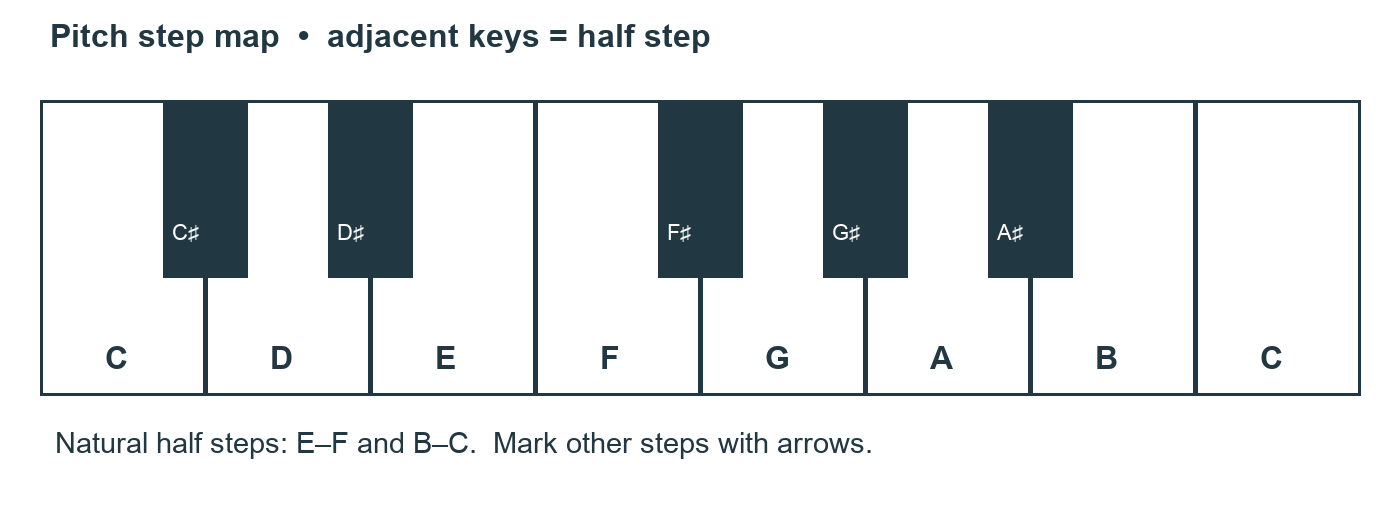
A half step is the distance between adjacent keys on a piano, including black keys. A whole step is two half steps. E to F and B to C are natural half steps. A scale is an ordered pitch collection; its tonic is its central or home pitch.
| Collection | Pattern or example | What to notice |
|---|---|---|
| Major | W W H W W W H; C D E F G A B C | G major uses F sharp; F major uses B flat |
| Natural minor | W H W W H W W; A B C D E F G A | A natural minor shares pitches with C major but has a different tonic |
| Harmonic minor | A B C D E F G sharp A | Raise scale degree 7 from natural minor |
| Classical melodic minor | Up: A B C D E F sharp G sharp A; down: A G F E D C B A | Raise degrees 6 and 7 ascending; return to natural minor descending |
| Major pentatonic | C D E G A | Five pitches; degrees 1 2 3 5 6 |
| Minor pentatonic | A C D E G | Five pitches; degrees 1 flat 3 4 5 flat 7 |
| Chromatic | Successive half steps | Twelve pitch classes in an octave |
| Minor blues collection | A C D E flat E G | An added flat fifth; blues practice also uses flexible pitch inflection |
| Readiness extensions | Dorian, Mixolydian, whole tone, and jazz melodic minor | Compare interval patterns and musical context; jazz melodic minor commonly keeps raised 6 and 7 in both directions |
A key signature establishes recurring sharps or flats; a local accidental can change a note. An interval measures the distance between pitches. Count letter names inclusively: C to E is a third, C to G a fifth, C to C an octave. Quality needs the actual half-step distance: C–E is a major third, C–E flat a minor third. A triad combines a root, third, and fifth; C–E–G forms C major, A–C–E forms A minor.
| Marking | Meaning | Paper practice |
|---|---|---|
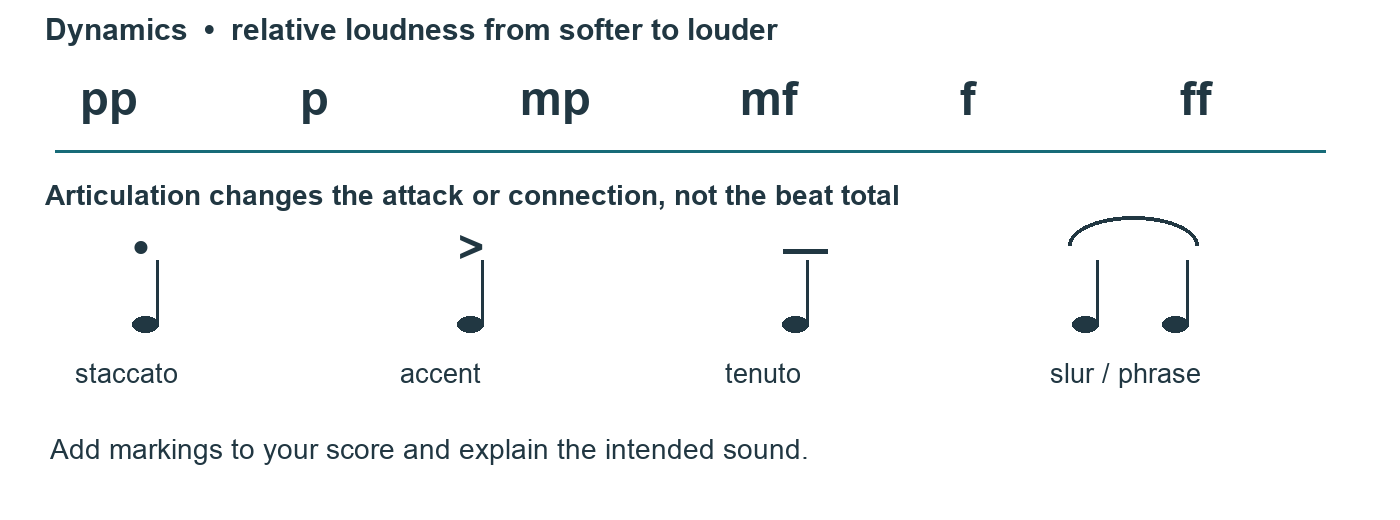
| pp p mp mf f ff | Very soft through very loud; relative to context | Mark a starting level and explain its purpose |
| Crescendo and diminuendo | Gradually louder or softer | Draw a hairpin under the affected passage |
| sfz and fp | A forceful accent; loud then immediately soft | Identify the exact event affected |
| Staccato | Detached or shortened | Use a dot above or below a note |
| Legato and slur | Connected gesture or phrase grouping | Draw the intended group |
| Accent and tenuto | Emphasized attack; sustained/full-value note | Compare the musical effect of > and a short line |
| Fermata and breath mark | Extend duration; indicate a planned breath or separation | Show how the ensemble coordinates the pause or release |
Tempo describes speed; dynamics describe relative loudness. A phrase groups notes into a musical thought. Plan its direction, arrival, and release. Orchestra players connect this to bowing; wind players and singers connect it to air, articulation, and breath. Music Explorations studies the musical intention on paper and through listening.
| Sound source | Examples | Possible jobs |
|---|---|---|
| Strings | Violin, viola, cello, bass, guitar, harp | Melody, bass, harmony, texture |
| Woodwinds | Flute, clarinet, oboe, bassoon, saxophone | Melody, countermelody, harmony, color |
| Brass | Trumpet, horn, trombone, tuba | Melody, harmony, bass, accents |
| Percussion | Drums, cymbals, marimba, timpani | Pulse, color, or pitched ideas |
| Keyboard and electronic | Piano, organ, synthesizer, sampled sounds | Pitch, harmony, rhythm, or changing texture |
| Voice | Solo voice, choir, spoken or sung delivery | Lyrics, melody, harmony, rhythmic delivery |
These are useful groupings, not limits on an instrument’s job. Timbre is tone color; texture describes how parts relate. Monophony has one melody line, homophony foregrounds a melody with support, and polyphony combines independent lines. Instrument plans describe imagined sounds; students do not need to own or play them.
Choose a listener and intention. Study two supplied excerpts with creator, title, source, and cultural context. Use evidence to select a genre, tradition, or blend. Plan contrasting sections: AB, ABA, or a verse and chorus. A hook is a memorable returning idea.
For a song, write original school-appropriate lyrics. Mark stressed syllables, align syllables with note starts, and leave room to hold words or rest. For a wordless piece, show a phrase and contour plan. Build two four-bar sections, check their pitch and rhythm, add purposeful expression, and revise after feedback. The core final product is an eight-bar written score or clearly labeled pitch-and-duration sketch. A recording is optional.
The redesign draws on Colorado’s 2022 music standards, especially novice musical literacy, creation, listening, and evaluation. Skill level depends on experience and demonstrated readiness rather than grade alone. More experienced students extend the same tasks.